


Japanese Post Box: Slots, Collection Times, and What You Can Send (2026)

A Japanese post box (郵便ポスト, yuubin posuto) is the red mailbox, marked with the 〒 postal symbol, where most domestic mail in Japan starts its journey. Japan Post operates about 175,000 of them nationwide. Most have two slots, with the left one for letters and postcards and the right one for larger items such as Letter Packs and international mail. Each box shows its collection times, and the last pickup is usually before 6pm.
A post box accepts anything that fits through the slot with postage already paid: a 110 yen letter, an 85 yen postcard, a 430 or 600 yen Letter Pack, a 360 yen Yu-Packet, or a 240 yen Click Post. Yu-Pack parcels and registered mail can't go in a post box. Yu-Pack, whose rates rose by an average of about 10% on October 1, 2026 and now start at 840 yen, has to be handed in at a post office counter or a convenience store such as Lawson, or collected by requesting a home pickup.
Beyond the post box itself, Japan Post can also be accessed at a local post office, at partner convenience stores like Lawson, or, if you're not in Japan to check your mailbox at all, through a virtual mailbox service such as MailMate.
This guide covers how to use a Japanese post box for domestic and international mail, what each Japan Post service costs, and how to receive and even send mail without setting foot in a post office.
What is the Japanese post box?

Common Japanese post boxes
A Japanese post box is a red mailbox for mail in Japan. These post boxes are very recognizable by their bright red color and the 〒 symbol representing Japan's postal system.
The 〒 symbol is widely believed to be a stylized version of the katakana character te (テ), the first sound in Teishin (逓信), the name of the ministry that ran Japan's post office before modern reorganizations. It was announced on February 8, 1887, first mistakenly as a "T" and then corrected to 〒 days later, which is why February 8 is still marked as Postal Mark Day in Japan.
Japan's postal system itself dates back further, to 1871, when the first collection boxes were simple, unpainted wooden boxes. In 1872, black-painted wooden pillar boxes (黒塗柱箱, kuronuri hashirabako) appeared when mail service opened within Tokyo. They carried a "POST" label, which is why mailboxes are still called posuto (ポスト) in Japanese today. The red era began in 1901, when fire-resistant iron boxes painted red were introduced.
You may see the regular Japanese post boxes decorated on the outside to reflect the season or holiday. Other times, you will see a special Japanese post box design.

Special Japanese post boxes
Japan Post mail and packaging

Japan Post has many types of mail and packages to accommodate items people may send each other. For all these items, you can write the address by hand.
Regular mail (普通郵便, futsuu yuubin)
Letters (手紙, tegami)
Postcards (葉書, hagaki)
-
Letter Pack (レターパック, letaa pakku): a cardboard envelope for A4-sized items up to 4kg There are two versions, and both include tracking and can be dropped in a post box if they fit through the slot.
Letter Pack Plus (レターパックプラス): For items up to 4 kg, costs 600 yen and guarantees in-person delivery with a signature.
Letter Pack Light (レターパックライト): For items up to 4 kg and up to 3cm thick, costs 430 yen, with delivery straight to the recipient's mailbox.
Yu-Pack (ゆうパック, yuu-pakku): for parcels up to 170cm in combined length, width, and height and 25kg, or up to 30kg as heavy Yu-Pack (重量ゆうパック). Every Yu-Pack is tracked and covered for up to 300,000 yen. Specialty versions handle golf clubs, ski equipment, and luggage sent to an airport.
Chilled Yu-Pack (チルドゆうパック, chirudo yuu-pakku): for refrigerated items such as fresh food.
Yu-Mail (ゆうメール, yuu meeru): for sending books, printed materials, and CDs/DVDs within Japan. Japan Post changed Yu-Mail's base rates on November 1, 2025.
Registered Mail (書留, kakitome): for safe delivery of important documents and valuables. It records the item at acceptance and delivery and compensates you for loss or damage. Simple registered mail covers up to 50,000 yen.
Collect shipping (着払い, chakubarai): the recipient pays the shipping cost on delivery.
Cash on delivery (代金引換, daikin hikikae): the recipient pays for the goods themselves on delivery. Japan Post charges a 290 yen COD fee, plus a separate fee to remit the collected money to you.
Service |
Price |
Best for |
Post box? |
Tracking |
Regular letter (定形郵便, up to 50g) |
110 yen |
Everyday letters and documents |
Yes |
No |
Postcard (はがき, hagaki) |
85 yen |
Short notes, greeting cards |
Yes |
No |
Click Post (クリックポスト) |
240 yen (from Oct 1, 2026) |
Small items up to 2kg, paid and labeled online |
Yes, post box only |
Yes |
Yu-Packet (ゆうパケット) |
360 yen flat (from Oct 1, 2026) |
Items up to 1kg and 3cm thick |
Yes |
Yes |
Letter Pack Light |
430 yen |
A4 documents up to 4kg and 3cm thick |
Yes |
Yes |
Letter Pack Plus |
600 yen |
A4 items up to 4kg, signature on delivery |
Yes, if it fits |
Yes |
Simple registered mail (簡易書留, kan-i kakitome) |
Base postage + 350 yen |
Documents needing proof of delivery, up to 50,000 yen coverage |
No, counter only |
Yes |
Yu-Pack (ゆうパック) |
From 840 yen (60 size, same prefecture, from Oct 1, 2026) |
Parcels up to 170cm and 25kg |
No, counter, conbini, or pickup |
Yes, plus up to 300,000 yen coverage |
Letter, postcard, Letter Pack, and registered mail prices reflect Japan Post's October 2024 domestic revision and the October 2023 option-fee revision. Yu-Pack, Yu-Packet, and Click Post prices reflect the revision that took effect on October 1, 2026, when Yu-Pack base rates rose by an average of about 10%. The Yu-Pack price depends on the day Japan Post accepts the parcel, its size (60 to 170), and the distance between origin and destination. Use Japan Post's rate calculator for the exact price on your route.
Tracking is the biggest practical difference between these options: regular letters and postcards have no tracking at all, so there's no way to confirm delivery once you drop one in a Japanese post box. Letter Pack (both versions), Click Post, Yu-Packet, registered mail, and Yu-Pack all include tracking numbers you can check on Japan Post's website, which is worth the extra cost any time you need confirmation that something arrived.
Yu-Pack can be dropped off at post offices or at participating convenience stores, not just collected from your home, which makes it easy to send even if you're not near a post office during business hours.
Yu-Pack discounts were not part of the October 1, 2026 rate change, so these amounts still apply:
At the counter: bringing a Yu-Pack to a post office or convenience store yourself saves 120 yen per parcel. You can add 60 yen off for sending to an address you shipped to within the past year, or 60 yen off per parcel for sending two or more to the same address at once, but not both.
In the app: creating the label and paying by card in the Japan Post app (郵便局アプリ) saves 180 yen per parcel instead. Choosing a post office as the pickup point saves another 100 yen.
App and counter discounts cannot be combined.
You can also request express delivery (速達郵便, sokutatsu yuubin) for base postage plus 300 yen for items up to 250g. Express mail is delivered every day, including weekends and holidays. Ordinary mail (普通郵便, futsuu yuubin) usually arrives two or more days after posting and is not delivered on Saturdays, Sundays, or holidays, a change Japan Post made in October 2021.
Japan Post also handles international shipping, including EMS (Express Mail Service), airmail, surface mail, and ePacket Light. Anything containing goods needs a printed label with customs data, while letters and postcards can still be addressed by hand.
Yu-Pack prices from October 1, 2026
Japan Post raised Yu-Pack base rates on October 1, 2026, by an average of about 10%, citing rising labor and materials costs. The increase depends on size and distance:
Parcels sent within the same prefecture rose about 2%.
Parcels up to 120 size crossing prefecture lines rose about 10%.
Parcels of 140 size and above rose about 20%.
The largest jump is about 35%, on a 170-size parcel from Tokyo to Okinawa (4,350 yen to 5,870 yen). The rate depends on the day Japan Post accepts the parcel, not the day you packed it.
Yu-Pack base rates sent from the Kanto region (Tokyo, Kanagawa, Saitama, Chiba, and neighbors), from October 1, 2026
Size |
Same prefecture |
Tohoku, Kanto, Shinetsu, Hokuriku, Tokai |
Kinki |
Hokkaido, Kyushu |
Okinawa |
60 |
840 yen |
970 yen |
1,090 yen |
1,550 yen |
1,600 yen |
100 |
1,480 yen |
1,650 yen |
1,780 yen |
2,220 yen |
2,480 yen |
140 |
2,160 yen |
2,600 yen |
2,760 yen |
3,220 yen |
3,430 yen |
170 |
3,060 yen |
3,680 yen |
4,500 yen |
4,970 yen |
5,870 yen |
These are base rates before any discount. Heavy Yu-Pack (25 to 30kg) adds 620 yen, and Airport Yu-Pack adds 880 yen. For every size and origin region, and the old and new rates side by side, see our guide to sending mail in Japan, which has the full October 2026 Yu-Pack rate table.
Ways to send mail: post box, post office, or convenience store
Sending mail from a Japanese post box

Japanese post box slots explained.
Most Japanese post boxes will have two slots to insert the items you want to send.
The left side is for regular or small mail, such as letters and postcards. The right side is for larger envelopes, Letter Packs, and international mail. On most boxes, the slot takes items only about 3cm thick. Since October 2021, Japan Post has been installing new boxes with slots that fit items about 7cm thick. Some smaller boxes have only one slot for everything.
Each box shows its collection times (取り集め時刻, toriatsume jikoku), and the last pickup is usually before 6pm. Times vary by box, can differ on weekends and holidays, and at some quieter boxes the only pickup is in the morning, and Japan Post treats the posted times as estimates. Anything posted after the last collection is picked up the next day and gets the next day's postmark. If a deadline depends on the postmark, take the item to a post office counter and ask for same-day processing.
Letters, postcards, and Yu-Packet need prepaid stamps. Letter Packs come with postage built into the envelope, and Click Post is paid online before you print the label. You can use Japan Post’s postage calculator to calculate the exact amount.
If you have trouble with the calculations, you can take the item to a post office counter instead (see below).
What you can and can't put in a Japanese post box
Can go in a post box |
Must go to a counter, conbini, or pickup |
Letters and postcards with stamps |
Yu-Pack parcels |
Letter Pack Light and Letter Pack Plus (if it fits the slot) |
Registered mail (書留), including simple registered mail |
Yu-Packet with stamps |
Anything too large for the slot |
Click Post (post box only from October 1, 2026) |
Items needing a same-day postmark after the last collection |
International letters and postcards |
International parcels with goods (printed label required) |
Sending mail at the Japan Post Office
If you don't have stamps or are unsure about the postage price, the best option is to go directly to the Japan Post office.
I use this option whenever I send domestic letters and international parcels.
The staff will categorize and weigh the item you want to send. Once the price is determined, you will pay for that postage.

Inside of a Japan Post office | Image via MyTravelGeno
Larger Japan Post offices will have a number-ticketed system, so take one when you arrive. Otherwise, it will be on a first-come, first-served basis.
Also, larger offices are open on the weekend within limited hours. For more information, check the information for your nearest Japan Post office.
These Japanese post offices will have specialty items, including stamps, letters, envelopes, and year-end gifts to buy.
Sending mail from a convenience store
If there is no Japanese post box or office near you, stop by a Lawson to send your mail.
In January 2003, Lawson installed post boxes in all of its stores under a partnership with Japan's postal service that began in 2002, and every Lawson has also accepted Yu-Pack since November 2004. This partnership allows you to drop off your mail at a Lawson, just like a regular Japanese post box.

A Japanese post box at a Lawson | Image via Tokukita.jp
Most Japanese convenience stores also sell standard stamps for letters and postcards, but not all do, so look for the 〒 sign at the entrance.
How do I receive Japanese mail?
There are many ways to receive mail in Japan. Most of the time, it will be placed in your mailbox. However, certain mail items need the receiver’s signature to indicate that you have received them.
If you are not in Japan and want to view your Japanese mail online, consider MailMate!
MailMate
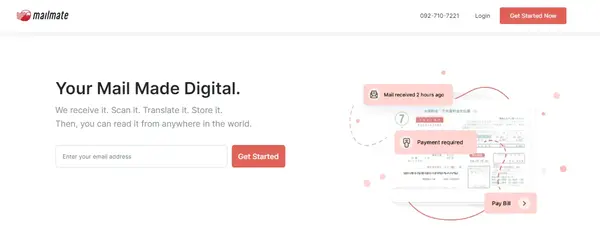
When MailMate receives your mail, you will get an email or Slack notification of its arrival. As a virtual mailbox service, your mail will be scanned into your dashboard for your online viewing.
You can open, forward, and shred your mail from here upon your request. MailMate will even pay your utility bills when you are away from Japan.
Additionally, MailMate can now send mail for you too, not just receive it.
With the Send Mail feature, you upload a document to your dashboard, choose a carrier, Japan Post, Yamato, Sagawa, FedEx, or DHL, and MailMate prints, packs, and posts it on your behalf.
Need registered mail (書留) with proof of delivery for a government filing? That's handled the same way.
If a Japanese agency sends you a form that needs to be filled out and mailed back, such as a tax office correction notice or a ward office registration, MailMate's bilingual team can complete the Japanese-language form for you and mail the reply directly from that same inbox item.
Every outgoing piece gets a tracking number and delivery confirmation, giving you documented proof that a filing was postmarked and received before its deadline.
Other options include cash on delivery, parcel lockers, convenience store pickup services, or requesting redelivery.
If you'd rather not use your home address at all, there are two ways to get a PO box in Japan: through Japan Post directly, or through a private PO box company. Japan Post's own PO boxes, called shishobako (私書箱), sit inside the post office itself and are free to use, but come with real eligibility conditions: you need to receive mail almost every day, plan to use the box for at least six months, and be able to collect your mail promptly rather than letting it pile up.
To apply, you check availability and submit a usage request form (利用請求書, riyou seikyuusho), at the post office where you want the box, along with identification, and availability depends on that specific post office having an open box. Private PO box companies aren't affiliated with Japan Post and generally don't enforce the same daily-mail or six-month requirements, which makes them a better fit for occasional or short-term use; they typically charge a monthly fee, and unlike Japan Post's boxes, which require you to pick up mail in person, some private services will forward your mail to another address for you.
If you only need to pick up mail occasionally, you don't need a PO box at all. Under kyokudome (局留), you can have mail sent to any of about 24,000 post offices and collect it at the counter with ID. It is free, needs no registration, and the post office holds items for 10 days before returning them. Private PO box operators in Japan are required to verify each customer's identity under anti-money-laundering rules, so expect to show identification there too.
Japan Post Redelivery

JapanPost's attempted delivery notice slip
For any mail that needs a signature, such as the Letter Pack Plus or Yu-Pack items, and you are not home, the delivery person will slip a redelivery paper into your mailbox.
This notice will have a QR code to scan to reschedule a redelivery. Pick a convenient date and time for the delivery person to return.
Sending international mail from Japan
Handwritten labels are allowed on international letters and postcards from Japan. The format should follow the international address format.

How to send international mail visas air mail | Image via Japan Post
However, sending packages from Japan is largely different. The main difference is that you will need a printed international parcel label. For most destinations, Japan Post offers three main options: EMS, its fastest and most trackable service, at about 3 to 18 days; standard airmail at about 5 to 21 days; and sea mail, the cheapest option, at about 2 to 4 months since it travels by ship. These are Japan Post's own estimates, and actual times depend on the destination.
Japan Post's economy SAL (Surface Air Lifted) service, which used to sit between airmail and sea mail in both price and speed at around 6 to 13 days, has been suspended since the COVID-19 pandemic, and in February 2025 Japan Post said it had no timeline for restarting it. For businesses and high-volume shippers, Japan Post also offers UGX (Yu Global Express), an international courier service for account customers, with a faster "UGX Prime" tier added in August 2026, but it requires deferred-payment approval and a Japan Post business card, and isn't something you can use as a walk-in individual option. Costs and delivery estimates vary by destination country and package weight; use Japan Post's website to check current rates and transit times for the specific country you're shipping to.
Bring the printed label and your package to your nearest Japan Post office. The item list is already included in the customs data you entered when creating the label.
If you don’t have a box, Japan Post will provide one for you at an additional cost of the box.
Frequently asked questions
What time is the last post box collection in Japan?
Each Japanese post box shows its collection times (取り集め時刻, toriatsume jikoku) on the front, and the last collection of the day is usually before 6pm, though times vary by box, can differ on weekends and holidays, and at some quieter boxes the only pickup is in the morning. Japan Post treats the posted times as estimates. Anything dropped in after the last collection is picked up the next day and gets the next day's postmark, so for a deadline where the postmark counts, hand the item in at a post office counter and ask for same-day processing.
Can I put a Yu-Pack in a Japanese post box?
No. A Japanese post box only accepts items that fit through the slot with postage already paid, such as letters, postcards, Letter Packs, Yu-Packet, and Click Post. Yu-Pack parcels have to be handed in at a post office counter or a participating convenience store such as Lawson, or collected from your home by requesting a pickup. Registered mail (書留, kakitome) cannot go in a post box either.
How much does Yu-Pack cost from October 1, 2026?
From October 1, 2026, a 60-size Yu-Pack (up to 60cm in combined length, width, and height) costs 840 yen within the same prefecture, after Japan Post raised base rates by an average of about 10%. Sent from Tokyo, the same parcel costs 970 yen to Kanto, Tohoku, Shinetsu, Hokuriku, and Tokai, 1,090 yen to Kinki, 1,550 yen to Hokkaido or Kyushu, and 1,600 yen to Okinawa. The largest 170 size costs 3,060 yen within a prefecture and up to 5,870 yen from Tokyo to Okinawa. Carrying the parcel to a counter yourself saves 120 yen, or paying in the Japan Post app saves 180 yen.
Can I send registered mail from a Japanese post box?
No. Registered mail (書留, kakitome), including simple registered mail (簡易書留, kan-i kakitome), must be handed in at a post office counter so it can be recorded at acceptance. Simple registered mail costs the base postage plus 350 yen and covers up to 50,000 yen, while general registered mail costs the base postage plus 480 yen. If you cannot get to a counter, Letter Pack Plus is the closest post-box alternative, since it is delivered in person with a signature.
How long does domestic mail take in Japan?
Ordinary letters and postcards usually arrive two or more days after posting, because Japan Post stopped Saturday delivery of ordinary mail on October 2, 2021 and pushed delivery back by about a day in stages from that month. Ordinary mail is not delivered on Saturdays, Sundays, or holidays. Express mail (速達, sokutatsu, base postage plus 300 yen for items up to 250g), registered mail, Letter Pack, and Yu-Pack are still delivered every day, including weekends and holidays.
What items can be sent internationally from Japan?
Most everyday goods can be sent internationally from Japan, including letters, postcards, documents, and small or large parcels by airmail, surface mail, or EMS. Chilled and frozen food can also go by Cool EMS to a limited number of destinations. Check the destination country's import rules before shipping, since each country bans different items.
What items cannot be sent internationally from Japan?
Items banned to every destination include aerosol cans, perfume, nail polish, fireworks, e-cigarettes, mobile batteries, and anything containing more than 24% alcohol, such as some sunscreens, hair tonics, and spirits. These dangerous goods cannot be sent even by sea. Each destination country also has its own list of prohibited imports, so check Japan Post's country pages before shipping.
What is Japan Post?
Japan Post (日本郵便, Nippon Yubin) is Japan's national postal operator. It is part of the Japan Post Group alongside Japan Post Bank and Japan Post Insurance, and it runs about 24,000 post offices and about 175,000 post boxes nationwide, handling letters, postcards, and parcels such as Yu-Pack.
Can I get a PO box in Japan instead of using my home address?
Yes. Japan Post lends PO boxes, called shishobako (私書箱), free of charge at some post offices, but only to people who receive mail almost every day, will use the box for at least six months, and can collect their mail promptly. You check availability at the post office where you want the box and submit a usage request form (利用請求書, riyou seikyuusho). If you only need to collect mail occasionally, any of about 24,000 post offices will hold mail for you for free for 10 days under kyokudome (局留), with no registration needed. Private PO box companies are another option, and they are required to verify your identity under Japan's anti-money-laundering rules.
Can a virtual mailbox service send mail on my behalf, not just receive it?
Yes, with a service like MailMate. Beyond receiving, scanning, and forwarding incoming Japanese mail, MailMate's Send Mail feature lets you upload a document from anywhere and have it printed, packed, and mailed through Japan Post, Yamato, Sagawa, FedEx, or DHL, including registered mail for filings that need proof of delivery. This is useful for anyone who needs to reply to a Japanese government notice or file paperwork by post without visiting a Japanese post office in person.
In closing
Using a Japanese post box comes down to three things: use the left slot for letters and postcards and the right slot for larger items, post before the last collection time shown on the box, and remember that Yu-Pack parcels and registered mail can't go in a post box at all.
With Yu-Pack rates having risen by an average of about 10% on October 1, 2026 to a new starting price of 840 yen, it is also worth checking whether a 240 yen Click Post or a 430 yen Letter Pack will do the job. If you are ever unsure, the staff at any post office can weigh your item and tell you the right service and price.
일본 우편물 처리에 너무 많은 시간을 소비하고 있나요?
가상 우편함 + 번역 서비스는 월 3800원부터 시작합니다. 30일 환불 보장.